Designing a self-expression feature for a youth mental health platform — in under 48 hours, as a team we'd never met before
Context
Girls in Tech Australia ran a remote hackathon themed around "Technology for Humanity." Teams were partnered with selected charities to respond to real challenges those organisations faced. Our team was matched with Orygen Digital — the organisation behind MOST, a free digital mental health service platform for young people aged 12–25, available via referral through youth mental health services across Vic, Qld, NSW, and the ACT.
MOST's goal is to provide a safe social network where young people can be heard and connect with peers who've been through similar experiences — reacting to, contributing to, and posting about their lives in a moderated, supportive environment.
My role
On day one I stepped up to direct the team's workflow and facilitate our ideation session — it was the first time any of us had worked together, and someone needed to get us moving. I ran a Crazy 8s workshop to generate concepts and led the stakeholder alignment session that narrowed our direction.
On day two I owned the Prompt Wizard prototype end-to-end — from user flow through low-fi to hi-fi — and also helped the other designer prototype her screens in Figma. Our full team was six people: two UX/UI designers (myself and Angela), two back-end developers, one front-end developer, and a project manager.
The problem
The stakeholder brief gave us a clear problem: young people on MOST want to express themselves, but creating a post from a blank screen is hard — especially when you're already struggling. User feedback from the stakeholder painted a consistent picture:
Our constraints were tight. Less than 48 hours. Strict anonymity and confidentiality requirements. Solutions had to adhere to MOST's community guidelines and couldn't add moderation workload. Personas couldn't be shared due to privacy — the stakeholder described user needs verbally.
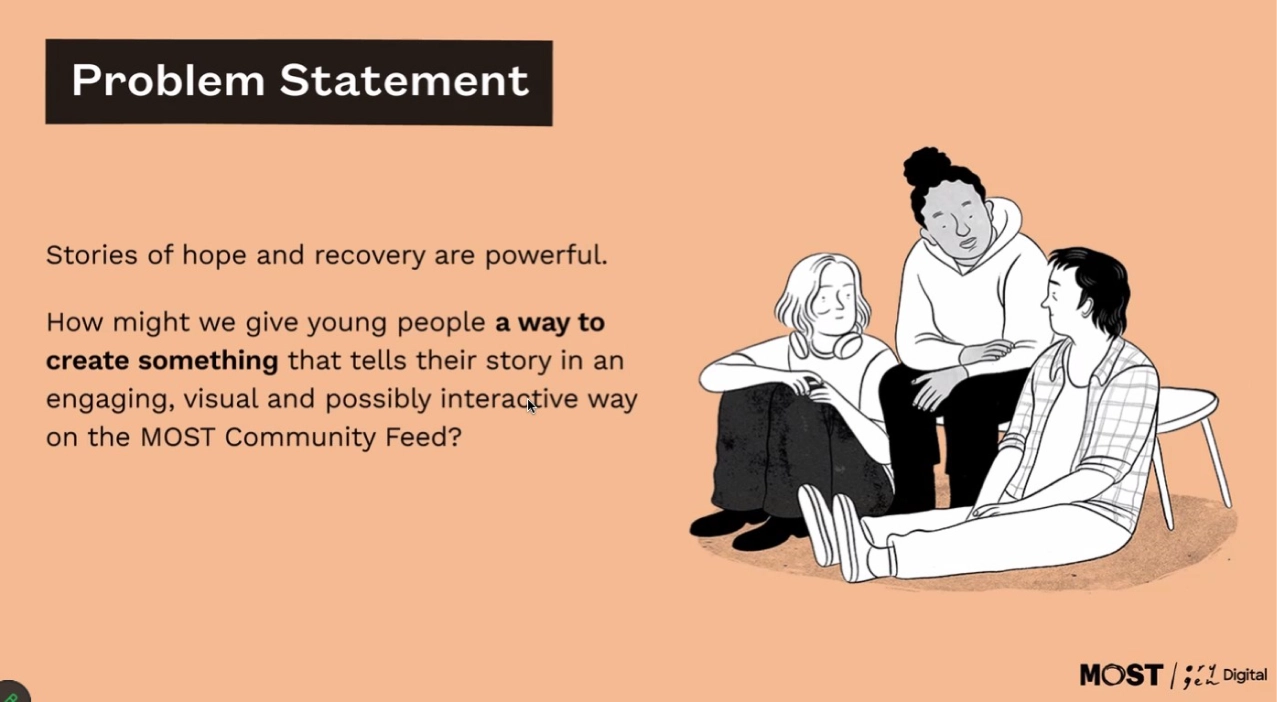
Problem statement — How might we give young people a way to express themselves and share their story in a safe space?
Research
With limited time, I ran rapid desktop research to understand MOST's context and looked at comparable platforms — Kooth, Headspace, and mental health-focused communities on Discord — to understand what patterns already existed for safe self-expression online. This gave us a baseline for what worked, what felt clinical, and what the community expected from a platform like MOST.
Ideation
I facilitated a Crazy 8s workshop with the team to generate a wide range of ideas quickly. We then ran a stakeholder alignment exercise — "Our Favourites" vs "Interesting Ones to Tackle" — to sense-check our concepts against feasibility and the platform's existing feature set.
Two concepts rose to the top:
The stakeholder confirmed both had potential to sit alongside existing MOST features — but noted the prompt system needed to remain positive in tone and mindful of the platform's therapeutic purpose. We also discussed how to run prompts that encourage users to express concerns while inviting peer responses.
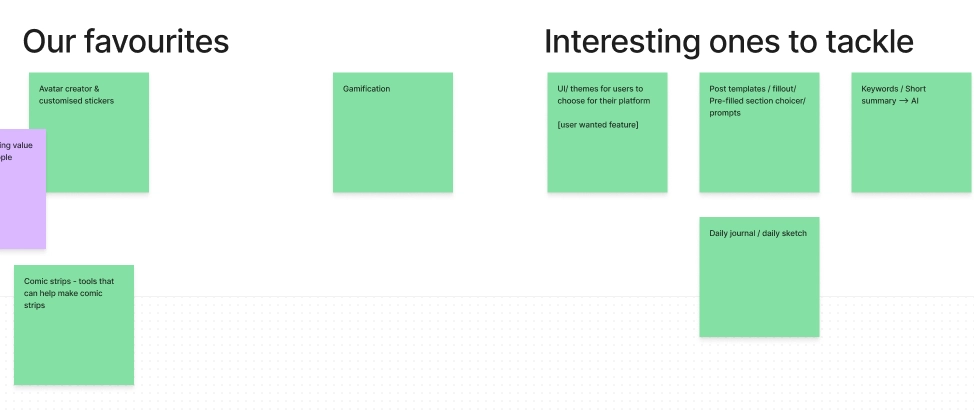
Stakeholder alignment exercise — sorting concepts by feasibility and platform fit
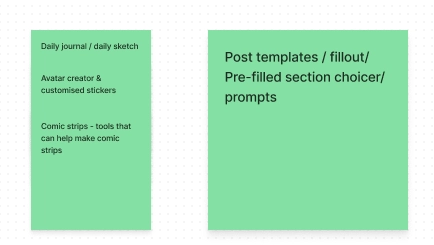
The two concepts that made it through — Sketch/Scribble and Post Template / Prompt Wizard
Design
I created a user flow to map exactly where the Prompt Wizard would sit within the existing MOST app — entry points, decision states, and how a completed prompt feeds into the Community Feed. Alongside this, I mapped out a set of questions and topics to understand how different prompts would guide a post while keeping the conversation tone aligned to MOST's community purpose.
The goal wasn't to tell users what to write — it was to lower the barrier enough that they could find their own words.

User flow mapping where the Prompt Wizard sits within the existing MOST app
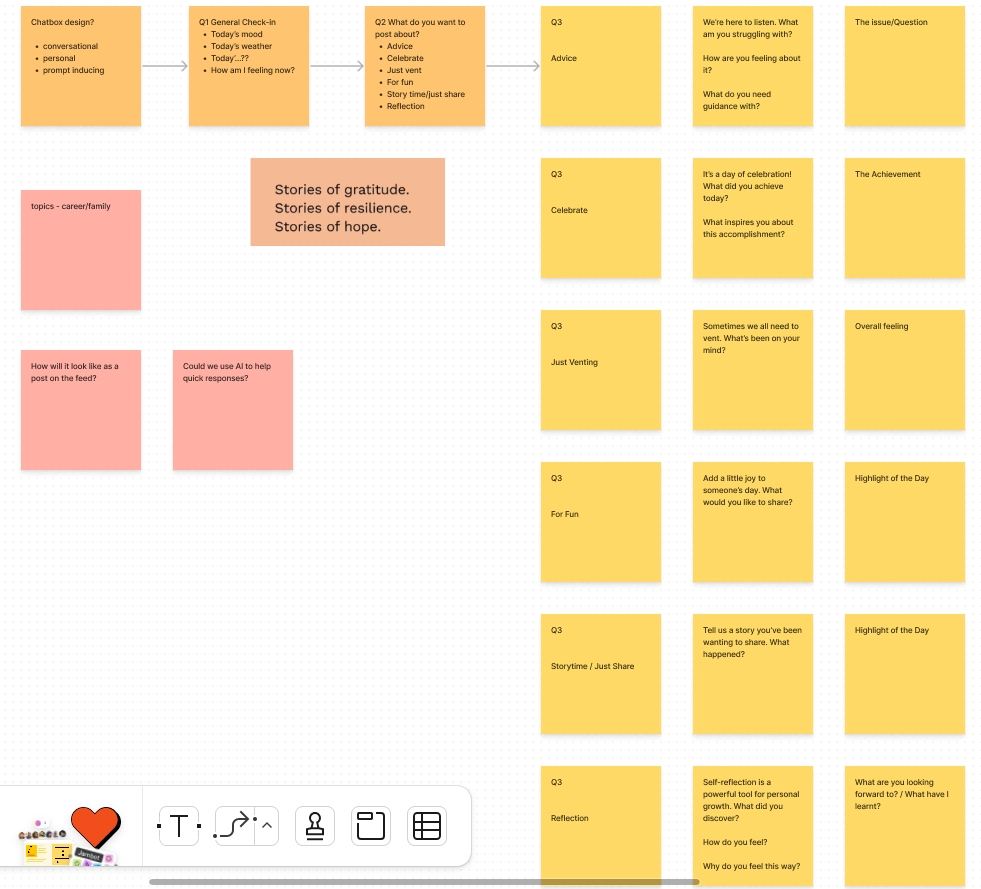
Mapping questions and topics to guide post creation while staying true to MOST's community tone
Low-fidelity wireframes established the concept structure. Once Angela and I both had our low-fis done, we switched over and linked our two flows together — connecting the Sketch and Prompt features into a single coherent prototype. Several simplifications were made at this stage: buttons were streamlined, CTAs narrowed, and the flow tightened to what could realistically be demonstrated in the time available.
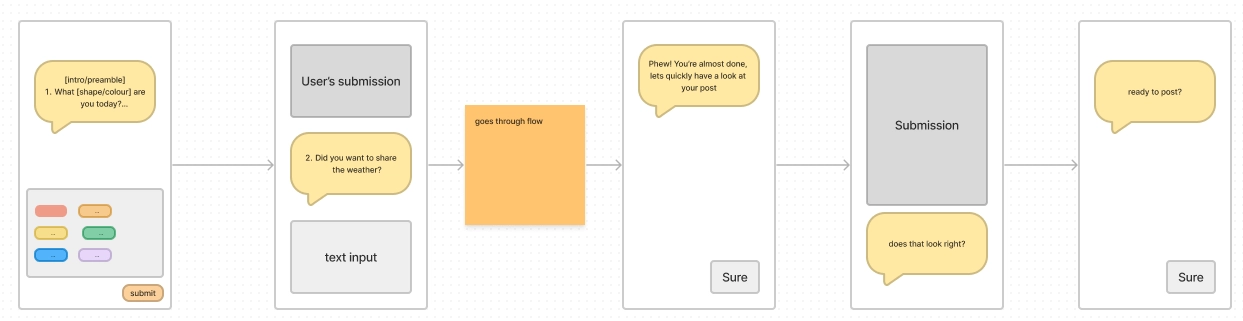
Low-fidelity frames before moving to hi-fi in Figma
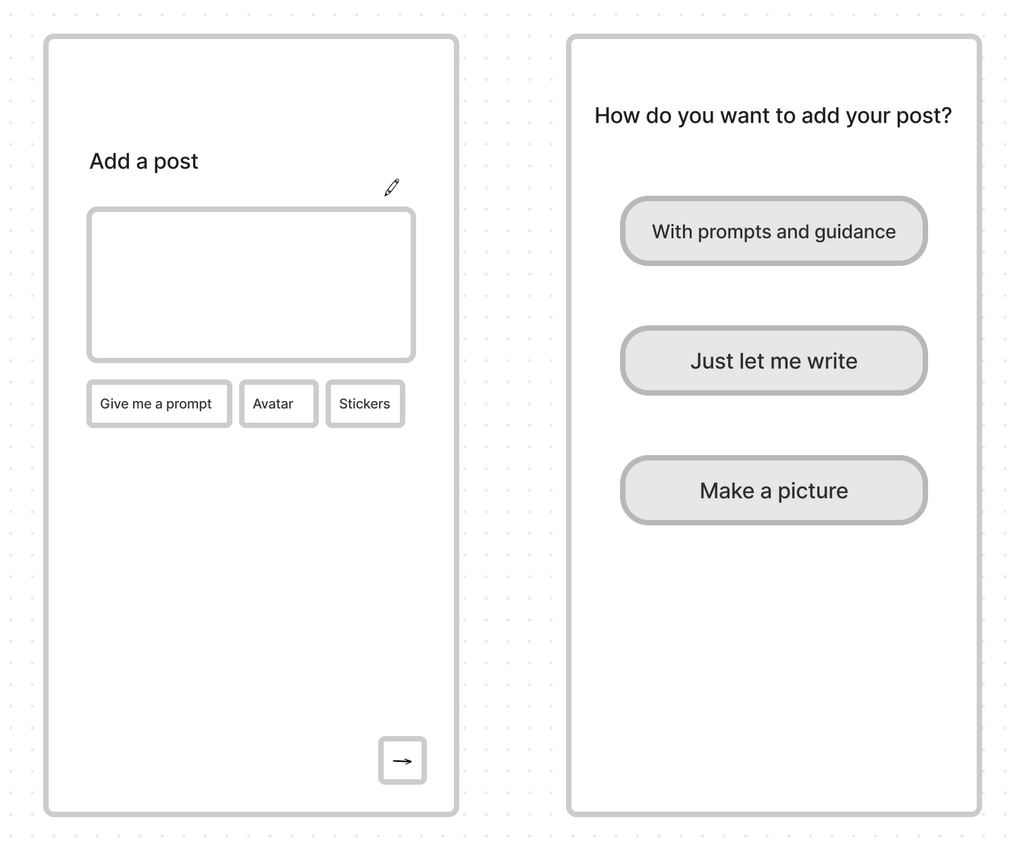
Connecting the two flows — Sketch/Scribble and Prompt Wizard linked into a single coherent prototype
The prototype
The final deliverable was a Figma prototype demonstrating both the Sketch/Scribble feature and the Prompt Wizard — showing how each would live within the existing MOST app experience. The rest of the team built the presentation deck covering the MOST overview, our solution rationale, feasibility considerations, and a future roadmap.
We presented to the full Girls in Tech cohort including the judging panel at 2pm on day two.
Figma prototype — Prompt Wizard and Sketch flows linked as a single clickable demo.
Outcome
Our team won the People's Choice Award — voted for by the hackathon audience, including other participants, mentors, and stakeholders. It wasn't the outcome I expected going into it.
"I was really on track and it was pleasantly surprised by the result — I was welcomed all the capability to step up and direct the workflow and facilitate what it seemed no one else was comfortable to do. Really appreciate the productive decisions of a team that was established on the morning of the hackathon."
Reflection
This was my first hackathon. The biggest thing I took from it wasn't the prototype — it was realising I could step into a facilitation role under pressure, with strangers, and make it work. Getting six people aligned quickly enough to actually ship something coherent in 48 hours required as much communication design as visual design.
I was also grateful for the stakeholder time and the mentors who pushed us through the second day when momentum started to flag. The post-hackathon reflection confirmed what I suspected: the team dynamic we built in the first few hours was what made the result possible.
If I had more time, I'd have tested the Prompt Wizard questions with real users — the mapping I did was based on stakeholder-provided feedback, but the language and tone of individual prompts would benefit from iteration with the actual community.